



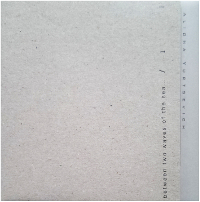
Aliona Yurtsevich
...in the stillness between two waves of the sea...
VIAGGIO INTERIORE [Awakening of Alice] (2009) for soprano, percussion, harp, 2 recorders and electronic tape; Equanimity of Old (2008) for mechanical organ and two players; Different Equations of Hesitation (2008) for prepared piano, harpsichord, percussion, 2 harps, trumpet, oboe, 2 recorders and 8-channel electronic tape; The Garden of Earthly Delights (2011) for solo accordion; ...in the stillness between two waves of the sea... (2010) electronic tape composition
Composer Aliona Yurtsevich has firmly situated herself within the “interdisciplinary” field of music composition, in which music is an alchemical substance that perfectly melts and unifies all other art forms – of word, gesture, image, idea, technology – into a transcendent and satisfying whole, with music itself as a co-dependent member of a broader alliance. Hers is a world in which music continually engages other sense modalities, reaches beyond the purely aural domain and seduces us into multiple responses in body, mind and heart. Each new piece involves a rethinking of form, medium and material, the nature of the performing space, the status of the performer's body and instrument, the extent of the bleed-through from music into visual or kinetic domains. As a composer Aliona Yurtsevich is developing her own unique style, exploring the traditional abilities of acoustic instruments with the emphasis on theatrical aspect of performance on stage, live electronics, sound spatialization and sound itself. Her work leans towards the experimental multidisciplinary sound-theater exploring musicality of the visual and the visuality of the musical performance. In her work she puts strong emphasis on researching the interrelation between different creative forms and languages in the musical context, where any additional media used are genetically embedded in the score from the start of the creation of the new work.
www.alionayurtsevich.com
Different Equations Of Hesitation: This piece is dealing closely and intimately with the perception of space in musical context, which was the main inspiration for the concept and musical material of the piece. Space, generally, is referred as physical and musical element - not only by placing musicians at opposite physical locations in the performance space, but also by arranging musical material using contrast musical textures and instrumental timbres to create an illusion of physical space within musical medium. The acoustics of the space play the role of a living, self-balancing surface - that is constantly being penetrated by suddenly appearing musical motives and textures – which “observes and defines” their relationships and provides the ground for these musical elements to resolve their “differences” and to blend within the musical context of the piece. Equanimity Of Old: The inspiration for the piece was the instrument itself - Bätz's mechanical organ and its unique sonority. By manually controlling air in the pipes it reveals its beautiful, rich in overtones and fragile micro-tonal language, which goes beyond classical organ music tradition, exposing 'hidden' overtones and harmonies that are not possible to notate by classical notation precisely. A special notation was specifically created to depict the slightest movements of the stops. Due to its fragile microtonal world this piece is not meant nor expected to sound the same every time it is being performed. It is an intimate dialog between the player and the instrument, where time as a fixed notion does not apply. VIAGGIO INTERIORE [Awakening Of Alice]: This work represents the invisible theater of a daring and puzzling journey into oneself, filled with a whimsical curiosity and abundant absurdity that one may go through in one's head. Juxtaposing harmony and chaos, order and disorder, it deals with an old philosophical question of what is dream and what is reality? Viaggio Interiore is a “silent drama”, a drama without “a drama”. It presents itself as the question and the answer at the same time: a question that one cannot ask, and an answer that one cannot have. The sonic tapestry of its virtual musical reality invites an audience “to experience” the struggle between word and meaning, visible and invisible, seen and unseen. The “experience” in itself, in the way, might be an answer and is very personal to each individual listener. The Garden of Earthly Delights is based on the masterpiece by Bosch “The Garden of Earthly Delights”, with the aim to reenact and to transcribe visual imagery, human scenarios and emotions depicted in the painting into musical material, based on which this piece for constructed. ...In the stillness between two waves of the sea...: The presence of nothing and everything at the same time. 'One' affects 'another' - oscillating, vibrating between clarity and vagueness, transparency and opaqueness, between tranquility and restlessness, between wholeness and falling to pieces. Sparse, calm, almost still, almost silent, gently elevating and grounding again, penetrating air, passing through and passing by – the sounds and physical movements as one entity are striving together for a balance, sharing one space. Music becomes a 'physical' entity present in space, creating space within the space seamlessly blending different modalities of our perception into one unifying form.
...in the stillness between two waves of the sea...
VIAGGIO INTERIORE [Awakening of Alice] (2009) for soprano, percussion, harp, 2 recorders and electronic tape; Equanimity of Old (2008) for mechanical organ and two players; Different Equations of Hesitation (2008) for prepared piano, harpsichord, percussion, 2 harps, trumpet, oboe, 2 recorders and 8-channel electronic tape; The Garden of Earthly Delights (2011) for solo accordion; ...in the stillness between two waves of the sea... (2010) electronic tape composition
Composer Aliona Yurtsevich has firmly situated herself within the “interdisciplinary” field of music composition, in which music is an alchemical substance that perfectly melts and unifies all other art forms – of word, gesture, image, idea, technology – into a transcendent and satisfying whole, with music itself as a co-dependent member of a broader alliance. Hers is a world in which music continually engages other sense modalities, reaches beyond the purely aural domain and seduces us into multiple responses in body, mind and heart. Each new piece involves a rethinking of form, medium and material, the nature of the performing space, the status of the performer's body and instrument, the extent of the bleed-through from music into visual or kinetic domains. As a composer Aliona Yurtsevich is developing her own unique style, exploring the traditional abilities of acoustic instruments with the emphasis on theatrical aspect of performance on stage, live electronics, sound spatialization and sound itself. Her work leans towards the experimental multidisciplinary sound-theater exploring musicality of the visual and the visuality of the musical performance. In her work she puts strong emphasis on researching the interrelation between different creative forms and languages in the musical context, where any additional media used are genetically embedded in the score from the start of the creation of the new work.
www.alionayurtsevich.com
Different Equations Of Hesitation: This piece is dealing closely and intimately with the perception of space in musical context, which was the main inspiration for the concept and musical material of the piece. Space, generally, is referred as physical and musical element - not only by placing musicians at opposite physical locations in the performance space, but also by arranging musical material using contrast musical textures and instrumental timbres to create an illusion of physical space within musical medium. The acoustics of the space play the role of a living, self-balancing surface - that is constantly being penetrated by suddenly appearing musical motives and textures – which “observes and defines” their relationships and provides the ground for these musical elements to resolve their “differences” and to blend within the musical context of the piece. Equanimity Of Old: The inspiration for the piece was the instrument itself - Bätz's mechanical organ and its unique sonority. By manually controlling air in the pipes it reveals its beautiful, rich in overtones and fragile micro-tonal language, which goes beyond classical organ music tradition, exposing 'hidden' overtones and harmonies that are not possible to notate by classical notation precisely. A special notation was specifically created to depict the slightest movements of the stops. Due to its fragile microtonal world this piece is not meant nor expected to sound the same every time it is being performed. It is an intimate dialog between the player and the instrument, where time as a fixed notion does not apply. VIAGGIO INTERIORE [Awakening Of Alice]: This work represents the invisible theater of a daring and puzzling journey into oneself, filled with a whimsical curiosity and abundant absurdity that one may go through in one's head. Juxtaposing harmony and chaos, order and disorder, it deals with an old philosophical question of what is dream and what is reality? Viaggio Interiore is a “silent drama”, a drama without “a drama”. It presents itself as the question and the answer at the same time: a question that one cannot ask, and an answer that one cannot have. The sonic tapestry of its virtual musical reality invites an audience “to experience” the struggle between word and meaning, visible and invisible, seen and unseen. The “experience” in itself, in the way, might be an answer and is very personal to each individual listener. The Garden of Earthly Delights is based on the masterpiece by Bosch “The Garden of Earthly Delights”, with the aim to reenact and to transcribe visual imagery, human scenarios and emotions depicted in the painting into musical material, based on which this piece for constructed. ...In the stillness between two waves of the sea...: The presence of nothing and everything at the same time. 'One' affects 'another' - oscillating, vibrating between clarity and vagueness, transparency and opaqueness, between tranquility and restlessness, between wholeness and falling to pieces. Sparse, calm, almost still, almost silent, gently elevating and grounding again, penetrating air, passing through and passing by – the sounds and physical movements as one entity are striving together for a balance, sharing one space. Music becomes a 'physical' entity present in space, creating space within the space seamlessly blending different modalities of our perception into one unifying form.
