



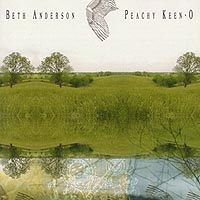
Peachy Keen-O
This CD has pieces with an auctioneer, a Kentucky farm with birds & clover, a jazz dancer, a quivering, vibrating, sexually tinged piece full of women saying supplication, a saint dying in flames, a drum piece about frustration, mother/daughter miscommunication, a pipe organ, and punk rap with overtones of yoga. Many of Anderson's compositions from 1973-1979 use words or parts of words to make either all or part of the music. Sometimes the music is derived from the words. Some of it is considered to be part of the genre known as text-sound.
(The following is edited from Beth Anderson's liner notes)
Peachy Keen-O (1973): This electro-acoustic piece is for female
voices, organ, electric guitar, vibraphone, large membranophones
& metalophones, improvisatory dancers, peach light and
pre-recorded tape. It is what my mother called "haunted house
music". Tower of Power (1973): This organ piece is a graphic
score. The recording on this CD is the first performance. The
ideal playback of this piece would be "as loud an amplitude as
possible, using both your ears and your equipment to decide".
Torero Piece (1973): The phonemic part of this text-sound piece
was derived from a paint-by-numbers scroll found in a used
clothing store. The vowels and consonants were chosen because
they exist in the Spanish language. (I had just heard ZAJ
perform and I was very enthusiastic about them). The
instruction for the reading part is to describe the most
dramatic event or relationship in your life. Each performer
writes his/her own speech. Joan (1974; 1977): In 1974 I made an
oratorio about Joan of Arc using the translation of the text of
her trial as the basis. I decoded the text into pitches and used
a modulating coding system with instructions and free rhythm.
The concert performance was amazing... However I was not able
to hear my modulating coding system clearly in all this, so I
made the version of that piece that is on this CD. This
fifteen-track all piano version of only the pitches was made in
1977. Ode (1975): "Ode" was created and mixed at the Queen's
College and Wesleyan electronic music studios. I Can't Stand It
(1976): When I first moved to New York I had a hard time
getting used to how things were here and this piece is a direct
response to that frustration. It was conceived for voice and
drum set. Yes Sir Ree (1978): This text-sound piece is based on
phrases used by Richard Levy and things his students mumbled
about him. He used to scream various encouraging words and
compliments at his students in the process of teaching his
class and his philosophy seemed to be that dancing was to be
enjoyed massively. Ocean Motion Mildew Mind (1979): This is a
Punk realization of "ommm". The words begin "ocean, motion,
mildew, mind" and continue "wishin', Titian, swishin', swine."
Country Time (1979): This piece is a cut-up of an additive
description of a walk around my family's farm in Kentucky in
early summer with a poem I wrote about other experiences in
Kentucky. It is for voice and percussion with or without
birdcalls.
Beth Anderson (b. January 3, 1950, Lexington, Kentucky) is a composer of avant-garde works that have been performed all around the world and that have brought her much acclaim; she is also active as a critic, pianist and vocalist. Ms. Anderson earned half a PhD at New York University, majored in piano performance at the University of Kentucky from 1966-68 and earned her BA in music from the University of California in 1971. She studied further at Mills College in Oakland, California and earned her MFA in piano performance, 1973 and her MA in composition, 1974. She was co-editor of the publication Ear from 1973-79 and is currently a teacher at the Greenwich House Music School, New York. Over the years, Ms. Anderson has studied with Robert Ashley, Larry Austin, John Cage, and Terry Riley, among others. She is a pioneer in the field of text-sound music, which uses words and phonemes to make a kind of vocal-percussive music.

 Reviews - by John de Clef Piñeiro
