



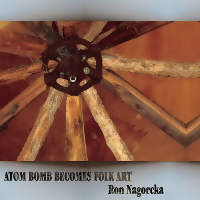
Ron Nagorcka
Atom Bomb Becomes Folk Art
Please note: This release packaging comes folded into quarters, ending up as a 5 ½” x 5 ½” brochure style booklet (liner notes inside), with the CD in a paper sleeve, all inserted into re-sealable plastic sleeves. There is no jewel case, tray card etc. There is a bar code.
Pogus is very pleased to release this 2 CD set of Australian composer Ron Nagorcka's work, covering almost 40 years of his compositions from 1973-2006.
Atom Bomb (1977) (Golden Fur: Samuel Dunscombe, Judith Hamann & James Rushford, with cassette tape recorders, toy instruments and various other devices) In a music critique for The Australian newspaper in 1977 entitled Atom Bomb becomes Folk Art, Paul Utiger described one of Atom Bomb's performances from the late 1970s: "…The most important instruments … were the cassette recorders for which Nagorcka provided very detailed operating instructions. During the course of the piece they built up an elaborate collage of acoustically superimposed material which in turn was played at the end." This performance by Golden Fur is the first in thirty years. This group of young Melbourne musicians with their creative use of amplification and choice of toy instruments, take the notion of creative analog distortion to new levels. Finite Differences (1973) (Graham Cox & Ron Nagorcka, pipe organ duet) This is one of Nagorcka's first pieces. Extensive use is made of the instrument's mechanical stop action to control the amount of air passing through the pipes, producing many intriguing effects. In Modulations (1974/83/2012), a group of instrumentalists interpreted one note (in various octaves) according to a graphic score while reel-to-reel tape loops and a VCS3 synthesiser were set-up to add effects. Requiem (in memoriam Ian Bonighton) (1976) (Ron Nagorcka, pianoforte) Ian Bonighton was a young Melbourne composer who was an especially valued and loved teacher. This Requiem was written after his tragic early death, and is based on the theme ABGH derived from his name. Dawn in the Wombat Forest (1985) (Liza Lim, violin; Ron Nagorcka, clavichord, didjeridu, electronics) One morning in 1985, when Ron Nagorcka was living on the edge of the Wombat State Forest in Victoria, he recorded himself playing the didjeridu while slowly approaching a cassette tape recorder. The recording became the backing track for this largely improvisational piece with violin and (unamplified) clavichord which. Artamidae (2002) (Monte Mumford, conductor; Larry Polansky, fretless electric guitar & mandolin; Joe Cook, trombone; Jennie MacDonald, flute & piccolo; Karlin Love, clarinet & bass clarinet; Ron Nagorcka, MIDI keyboard & didjeridu) With the exception of the second piece (Australian Magpie), they are all written in just intonation. This is a tuning system based on the harmonic series that Nagorcka began to explore seriously once electronic instruments made the task relatively easy in the late 1980s. Just Bluffing for Quamby (2006) is 2 electro-acoustic pieces in just intonation based on the sounds of Quamby Bluff. With myriad degrees of light-dark infusion (2006) (Conductor, Simon Reade; Joe Cook, trombone; Karlin Love, clarinet; Melissa Chominsky, violoncello; Ron Nagorcka, MIDI keyboard) The title of this work is taken from a quotation below by American composer Harry Partch, who devised the scale of 43 tones per octave used in this piece. Little Penguins (1995) (Ole Jørgen Melhus, trombone; Ron Nagorcka, didjeridu & electronic keyboard) A raucous chorus of Little Penguins on a Tasmanian beach inspired this virtuosic and rhythmically complex interplay between trombone, didjeridu and keyboard, written in just intonation. Colluricincla harmonica (1998) (Larry Polansky, fretless electric guitar; Hans Meijer & Ron Nagorcka, electronic keyboards) Written for Larry Polansky in what seems to have been a successful attempt to help convince him keep an electric guitar fretless so that it can play alternative tunings. To be a pilgrim (2006)(Ole Jørgen Melhus, trombone; David Scott Hamnes, pipe organ; Ron Nagorcka, didjeridu) In the theme can be heard echoes of the English traditional melody adapted by Ralph Vaughan Williams for John Bunyan's wonderful hymn "Who would true valour see..."
Composer, performer, and naturalist Ron Nagorcka (born 1948) spent much of his childhood exploring music and the natural world on a sheep farm in Western Victoria (Australia). He went on to study history, pipe organ with Sergio de Pieri, harpsichord with Max Cooke, and composition with Keith Humble, Ian Bonighton and Jean-Charles Francois at Melbourne University and then composition and electronic music at the University of California San Diego, where his teachers included Kenneth Gaburo, Pauline Oliveros, Robert Erickson, and John Silber. During the 1970s he was active as a composer in Melbourne where he founded the Clifton Hill Community Music Centre - providing a venue of considerable importance to many emerging composers and musicians of the time - and taught composition at the Melbourne State College. In 1986 he visited Tasmania as a tutor at the National Young Composers School in Hobart, and decided to move to the island. Since 1988 he has been living and working in a remote forest in northern Tasmania, where he has built his own house and solar-powered studio. As an active field naturalist, he takes a keen interest in the science, as well as the aesthetics of the Australian bush. His recordings of nature also become the basis for many of his compositions. The melodies, rhythms, even the instrumental quality of the music are generated by painstaking listening and analysis of natural Australian soundscapes. Digital technology also enables him to explore a long held interest in the ancient tuning known as "just intonation". An analysis of birdsong provides the basis for the scales he designs. He also writes for conventional instruments using equal temperament. It was the influence of Australian indigenous culture - in particular the didjeridu players with whom he occasionally worked - who encouraged him to develop more of an understanding of the Land, and to reflect this in his music. He makes and plays his own didjeridus, and has incorporated this instrument into his music since 1974. The influence of traditional Aboriginal music is otherwise most evident in his rhythmical techniques.
Atom Bomb Becomes Folk Art
Please note: This release packaging comes folded into quarters, ending up as a 5 ½” x 5 ½” brochure style booklet (liner notes inside), with the CD in a paper sleeve, all inserted into re-sealable plastic sleeves. There is no jewel case, tray card etc. There is a bar code.
Pogus is very pleased to release this 2 CD set of Australian composer Ron Nagorcka's work, covering almost 40 years of his compositions from 1973-2006.
Atom Bomb (1977) (Golden Fur: Samuel Dunscombe, Judith Hamann & James Rushford, with cassette tape recorders, toy instruments and various other devices) In a music critique for The Australian newspaper in 1977 entitled Atom Bomb becomes Folk Art, Paul Utiger described one of Atom Bomb's performances from the late 1970s: "…The most important instruments … were the cassette recorders for which Nagorcka provided very detailed operating instructions. During the course of the piece they built up an elaborate collage of acoustically superimposed material which in turn was played at the end." This performance by Golden Fur is the first in thirty years. This group of young Melbourne musicians with their creative use of amplification and choice of toy instruments, take the notion of creative analog distortion to new levels. Finite Differences (1973) (Graham Cox & Ron Nagorcka, pipe organ duet) This is one of Nagorcka's first pieces. Extensive use is made of the instrument's mechanical stop action to control the amount of air passing through the pipes, producing many intriguing effects. In Modulations (1974/83/2012), a group of instrumentalists interpreted one note (in various octaves) according to a graphic score while reel-to-reel tape loops and a VCS3 synthesiser were set-up to add effects. Requiem (in memoriam Ian Bonighton) (1976) (Ron Nagorcka, pianoforte) Ian Bonighton was a young Melbourne composer who was an especially valued and loved teacher. This Requiem was written after his tragic early death, and is based on the theme ABGH derived from his name. Dawn in the Wombat Forest (1985) (Liza Lim, violin; Ron Nagorcka, clavichord, didjeridu, electronics) One morning in 1985, when Ron Nagorcka was living on the edge of the Wombat State Forest in Victoria, he recorded himself playing the didjeridu while slowly approaching a cassette tape recorder. The recording became the backing track for this largely improvisational piece with violin and (unamplified) clavichord which. Artamidae (2002) (Monte Mumford, conductor; Larry Polansky, fretless electric guitar & mandolin; Joe Cook, trombone; Jennie MacDonald, flute & piccolo; Karlin Love, clarinet & bass clarinet; Ron Nagorcka, MIDI keyboard & didjeridu) With the exception of the second piece (Australian Magpie), they are all written in just intonation. This is a tuning system based on the harmonic series that Nagorcka began to explore seriously once electronic instruments made the task relatively easy in the late 1980s. Just Bluffing for Quamby (2006) is 2 electro-acoustic pieces in just intonation based on the sounds of Quamby Bluff. With myriad degrees of light-dark infusion (2006) (Conductor, Simon Reade; Joe Cook, trombone; Karlin Love, clarinet; Melissa Chominsky, violoncello; Ron Nagorcka, MIDI keyboard) The title of this work is taken from a quotation below by American composer Harry Partch, who devised the scale of 43 tones per octave used in this piece. Little Penguins (1995) (Ole Jørgen Melhus, trombone; Ron Nagorcka, didjeridu & electronic keyboard) A raucous chorus of Little Penguins on a Tasmanian beach inspired this virtuosic and rhythmically complex interplay between trombone, didjeridu and keyboard, written in just intonation. Colluricincla harmonica (1998) (Larry Polansky, fretless electric guitar; Hans Meijer & Ron Nagorcka, electronic keyboards) Written for Larry Polansky in what seems to have been a successful attempt to help convince him keep an electric guitar fretless so that it can play alternative tunings. To be a pilgrim (2006)(Ole Jørgen Melhus, trombone; David Scott Hamnes, pipe organ; Ron Nagorcka, didjeridu) In the theme can be heard echoes of the English traditional melody adapted by Ralph Vaughan Williams for John Bunyan's wonderful hymn "Who would true valour see..."
Composer, performer, and naturalist Ron Nagorcka (born 1948) spent much of his childhood exploring music and the natural world on a sheep farm in Western Victoria (Australia). He went on to study history, pipe organ with Sergio de Pieri, harpsichord with Max Cooke, and composition with Keith Humble, Ian Bonighton and Jean-Charles Francois at Melbourne University and then composition and electronic music at the University of California San Diego, where his teachers included Kenneth Gaburo, Pauline Oliveros, Robert Erickson, and John Silber. During the 1970s he was active as a composer in Melbourne where he founded the Clifton Hill Community Music Centre - providing a venue of considerable importance to many emerging composers and musicians of the time - and taught composition at the Melbourne State College. In 1986 he visited Tasmania as a tutor at the National Young Composers School in Hobart, and decided to move to the island. Since 1988 he has been living and working in a remote forest in northern Tasmania, where he has built his own house and solar-powered studio. As an active field naturalist, he takes a keen interest in the science, as well as the aesthetics of the Australian bush. His recordings of nature also become the basis for many of his compositions. The melodies, rhythms, even the instrumental quality of the music are generated by painstaking listening and analysis of natural Australian soundscapes. Digital technology also enables him to explore a long held interest in the ancient tuning known as "just intonation". An analysis of birdsong provides the basis for the scales he designs. He also writes for conventional instruments using equal temperament. It was the influence of Australian indigenous culture - in particular the didjeridu players with whom he occasionally worked - who encouraged him to develop more of an understanding of the Land, and to reflect this in his music. He makes and plays his own didjeridus, and has incorporated this instrument into his music since 1974. The influence of traditional Aboriginal music is otherwise most evident in his rhythmical techniques.

